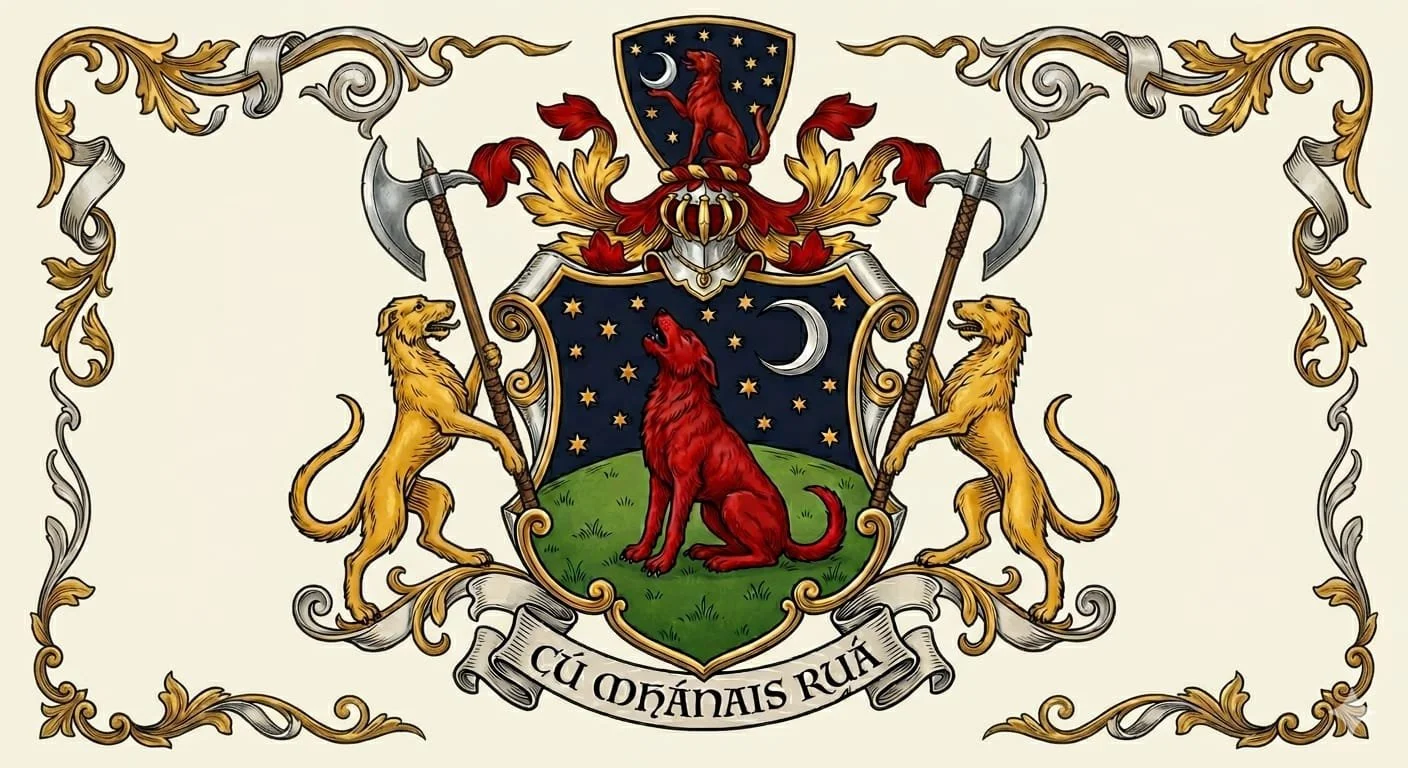
Cú Mhánais Rua LTD is a distinguished, family-owned enterprise operating under the directional leadership of Tomás Cú Mhánais Rua Mac Maghnuis. Company motto, "The Red Howling Hound," the corporation serves as the umbrella for a diverse portfolio of cultural, artisanal, and historical endeavors. Please note that Cú Mhánais Rua LTD operates as an entirely independent entity, distinct and separate from the CLG. Under Mr. Mac Maghnuis’s dedicated oversight, the enterprise successfully directs several premier initiatives. Caveman Graffiti Stone Masonry: A masterclass in artisanal craftsmanship, specializing in enduring stonework that honors traditional masonry techniques. Literary & Historical Arts: Author of the acclaimed historical novel, Darkest Light, alongside active leadership in living-history re-enactments that bring heritage to life. Clan Hobelar Sport: Preserving and promoting the distinct equestrian and martial traditions of Irish Style" Hobelar sport. Media & Digital Content: Curating high-quality educational and entertaining media, specializing in bespoke brewing content and engaging productions via YouTube. Corporate Ethos: To blend historical preservation with modern craftsmanship, guided by legacy and driven by familial pride.
The Governance and Heritage of the Clan McManus-House of McManus. In steadfast adherence to venerable Gaelic tradition, The Clan McManus (House of McManus) observes the ancient tenets of Brehon Law to govern the democratic election of its Chieftain. This foundational system operates in harmony with the Clan’s distinct structure, which comprises four recognized kindred groups. While historical precedents traditionally favoured male succession to the Chieftainship, the House of McManus modernizes this heritage through a philosophy of absolute egalitarianism. The ascension of a female leader, though historically rare, is firmly rooted in Irish tradition. A prominent testament to this is the 16th-century Chieftain and "Pirate Queen," Grace O’Malley (Granuaile). Under the flexibility of Brehon Law, she was elected to leadership by her own brothers and uncles, underscoring that capability and consensus transcend gender. Today, all female clanswomen possess equal eligibility for election to the Chieftainship. To maintain the symbolic integrity of the office, any candidate—whether male or female—must bear the historic McManus surname at the time of their election. The Clan formally recognizes female lines of descent, ensuring that lineage is honoured with equal merit across both maternal and paternal branches. Membership within the House of McManus is defined by shared bloodlines rather than nomenclature alone. Lineal descent from a common ancestor constitutes the sole prerequisite for official membership. Consequently, individuals of the bloodline who do not bear the McManus surname are embraced as full and rightful members of the Clan. The House of McManus operates as an egalitarian society. We are bound not by rigid hierarchy, but by a collective devotion to our ancestral heritage, mutual respect, and a steadfast commitment to our shared cultural values.
· The Four main kindred groups.
· Gelfine (Bright-kin): The smallest and most intimate circle, consisting of descendants of a common grandfather (e.g., a man, his sons, and grandsons). This group held the primary responsibility for the daily support of its members.
· Derbfine (True-kin): A four-generation group comprising descendants of a common great-grandfather. This was the most critical unit for chieftainship; any male member of a king's derbfine—including brothers, uncles, and nephews—was eligible to be elected as his successor (Tánaiste).
· Iarfine (After-kin): A larger unit comprising descendants of a common great-great-grandfather. While further removed, they still held contingent rights to inheritance if the gelfine or derbfine lines failed.
· Indfine (End-kin): The furthest recognized kin group, which some scholars identify as extending to descendants of a common great-great-great-grandfather. They were the outer limit of the family's legal accountability.
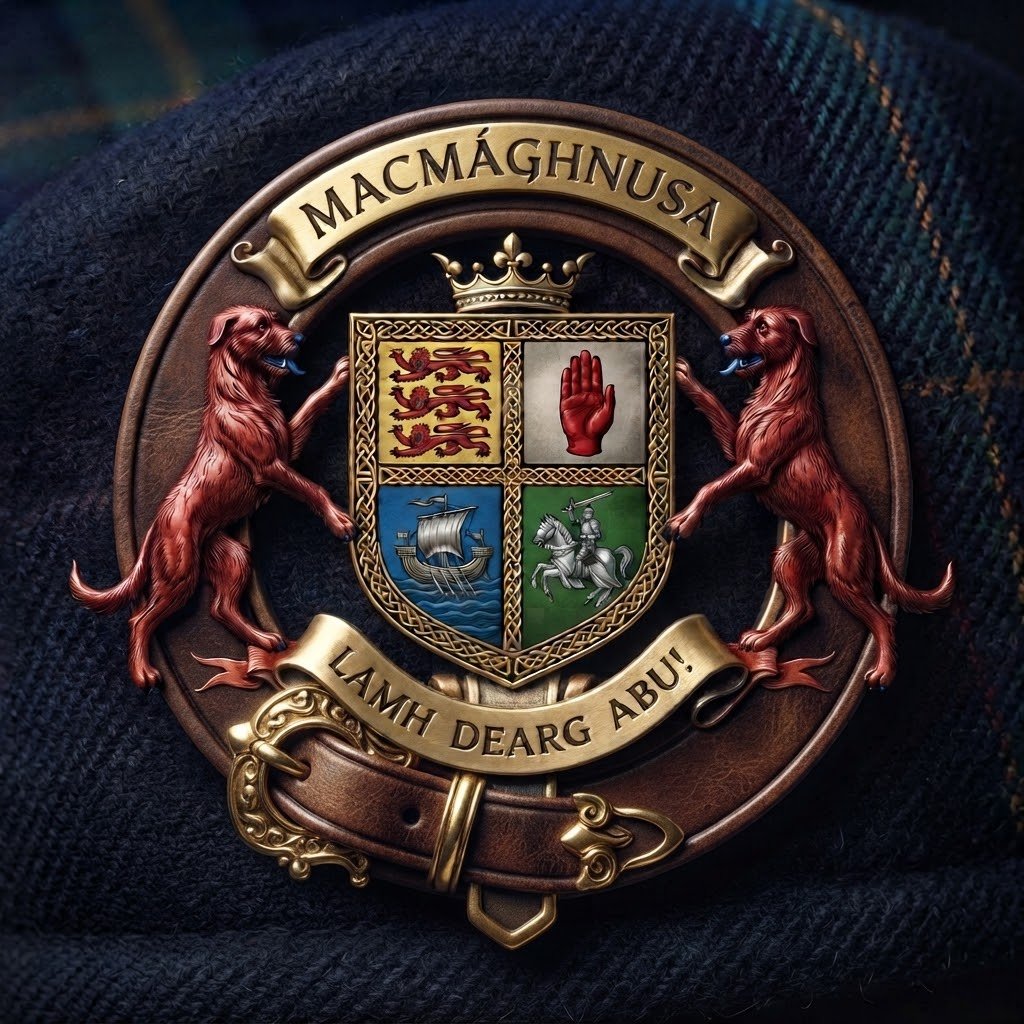
Clan McManus\House of Magnhus CLG.
The aim of our organization is to bring the members of Clan McManus together and to start a cultural resurgence by uniting its members through our common ancestry and heritage.
There are two separate Irish McManus Clans, one is descended from the O’Connor’s in County Roscommon and the other from County Fermanagh who are descended from the Maguires, we focus on the McManus’s from Fermanagh and only cover their history and the related Clans connected to them through common ancestry such as McCaffrey, McHugh, McAuley, and McMahon who are all branches of Clan Maguire.
We hold yearly gatherings at the historical seat of Clan McManus, Castle McManus on Belle Isle Upper Lough Erne Fermanagh is still standing and is a beautiful location we also do cultural summits at Enniskillen Castle, during these we do tours of Lough Erne.
Tomas Cú Mhánais Rua MacMagnhus is the Director of Cú Mhánais Rua LTD and Chairperson of Clan McManus\House of Magnhus CLG and handles all registrations, events, Charities and Environmental, Stone Masonry Business and You-Tube Channel, Historical re-enactments.
Our Ceremonial (Ri Tuatha, Mor McManus), is Thomas Patrick Mor McManus.
Our Ceremonial (Ururri, Cú Rua McManus) are Martin Cú Rua McManus, Margret Cú Rua McManus and Bernadette Cú Rua McManus.
Our Ceremonial (Taoiseach, Cú Mhánais Rua McManus) is Tomás Cú Mhánais Rua Mac Maghnuis.
Our Ceremonial (Tánaiste, Og McManus) is Tjay Og McManus.
Our Ceremonial (Ceann Fine, Don McManus) are Teresa Don McManus, John Don McManus, Francis Don McManus, Kelly Don McManus, Liam Don McManus, Claire Don McManus.
Our Ceremonial Rídhamhna are Sonny McManus, Jessica McManus, Sennan McManus, Sophie McManus, Niamh McManus, Charlotte McManus, Daniel McManus Haran, Lisha McManus Haran, Rachel McManus Haran, Ryan McManus Stallard, Brandon McManus Stallard, Alex McManus Stallard, Kevin McManus Dolan, Lauren McManus Dolan, Shannon McManus Machin and Wyatt McManus Machin, Harvey McManus Hawkins, Lacy May McManus Stallard, AriesMcManus Stallard, Athena McManus Stallard, Winter McManus Hawkins, Ruby McManus Haran, Conor McManus Bartley, Leah McManus Bartley, Ava McManus Bartley, Eoin McManus O'Donoghue, Aidan McManus O’Donoghue.
Our Ceremonial Banflaith is Marian McShane-McManus wife of Ri Tuatha.
Our Ceremonial Tiarna and Bantiarna are Stewart Stallard, Andrew Machin, Lenore McManus, Keely Pots, Josh Hawkins, Mathew Bartley, Charlotte Brian, Jenny Walsh, Ben Stewart.
A Clarification on Structure, Governance, and Cultural Heritage.
in the spirit of absolute transparency, humility, and historical fidelity, we wish to formally delineate the structural and legal frameworks of our organization. It is vital to state at the outset that the titles used within our collective are purely cultural and ceremonial markers of heritage, rather than indications of rigid hierarchy or aristocratic superiority. They exist as a courtesy to keep our ancestral memory alive, functioning as traditional designations within a modern, meritocratic framework rather than claims of dominion or archaic privilege. To provide full clarity on our operations, are two distinct, legally defined entities. Clan McManus-House of Magnhus CLG (Company Limited by Guarantee) This branch governs our registered non-profit trust. In strict adherence to Irish Charity Law, no board member or trustee listed within this section is permitted to accept a salary, wage or commercial dividend from the CLG’s assets. Principle of Service: Their positions are defined entirely by fiduciary responsibility, statutory transparency, and an unwavering commitment to cultural preservation. It is a labor of love and duty, devoid of financial self-interest. The Cú Mhánais Rua LTD This entity comprises the private family business, which is owned 100% and solely by Tomás Cú Mhánais Rua Mac Maghnuis. This commercial arm holds ownership of all physical assets, masonry tools, vehicles, and broadcasting intellectual property. Operational Framework: Within this section operates as a formal commercial entity, independent contractor, or salaried employee. Compliance: All compensation is structured strictly within the standard Irish PAYE/PRSI frameworks. On Lineage, Locality, and the Courtesy of Titles. We wish to state with the utmost sincerity that we do not claim Chieftaincy over all of the McManus name. Our stewardship extends solely to our own immediate Tuatha, rooted firmly in the historic Barony of Knockninny, County Fermanagh. The McManus Clan has inhabited this region for centuries, and while the wider diaspora has grown immensely over the generations, our specific responsibility remains the management of our direct branch. Our oldest recorded ancestor to date is John McManus (born 1715). While the paper trail prior to the 18th century presents the standard challenges of Irish genealogical research—which our members continuously work to unearth—our deep connection to the land is irrefutably validated by contemporary genetic science. Our DNA results place our lineage precisely within the Upper Lough Erne basin. We are, inherently, the McManus’s of Fermanagh; our roots run deep within the soil of the Lake County. Constitutional Alignment: We stand in complete agreement with the Constitution of the Republic of Ireland, which prohibits the conferring of titles of nobility. Furthermore, we acknowledge that the state discontinued the practice of recognizing "Chiefs of the Name" in 2003. We have never sought, nor applied for, confirmation from the Chief Herald of Ireland. Historical Context: True Irish Gaelic titles were effectively abolished between 1610 and 1690 following the collapse of the Gaelic order. We firmly believe that nobility should only ever exist as a meritocracy—earned through individual virtue and active only for the duration of that person’s lifetime. Cultural Revivalism: Consequently, the titles utilized within our company functions and Clan gatherings are purely ceremonial. They carry no claim to territory, sovereignty, or nobility. Instead, they serve as functional, symbolic roles within our company and events—a benign and respectful mechanism to revive the rich tapestry of Gaelic culture and honour the memory of those who came before us. Our Ultimate Vision. Our enduring ambition is to host annual gatherings at our historic ancestral seat on Belle Isle, Upper Lough Erne, Fermanagh. By convening in the very landscape where our ancestors lived, enjoyed success, endured misfortune, and held council, we seek to continue their legacy. Through these gatherings, we do not seek to elevate ourselves; rather, we seek to keep their memory vibrantly alive, celebrating a shared heritage through historical remembrance and mutual respect.
Note. The CLG is operated by its members Tomás Cú Mhánais Rua Mac Maghnuis, Thomas Patrick McManus, Teresa McManus, John McManus, Francis McManus, Kelly McManus, Tjay McManus, Jesscia McManus, Sophie McManus, Martin McManus, Bernadette McManus, Margaret McManus, Liam McManus, Claire McManus, Charlotte McManus, Sonny McManus, Sennan McManus, Niamh McManus, Daniel McManus Haran, Rachel McManus Haran, Lisha McManus Haran, Ryan McManus Stallard, Brandon McManus Stallard, Alex McManus Stallard, Shannon McManus Machin, Wyatt McManus Machin, Kevin McManus Dolan, Lauren McManus Dolan, Lacy May McManus Stallard, Aries McManus Stallard, Athena McManus Stallard, Ruby McManus Haran, Harvey McManus Hawkins, Winter McManus Hawkins, Conor McManus Bartley, Leah McManus Bartley, Ava McManus Bartley, Eoin McManus O'Donoghue, Aidan McManus O’Donoghue. The CLG covers our charity, environmental and cultural heritage preservation, gatherings and resurgence campaigns.
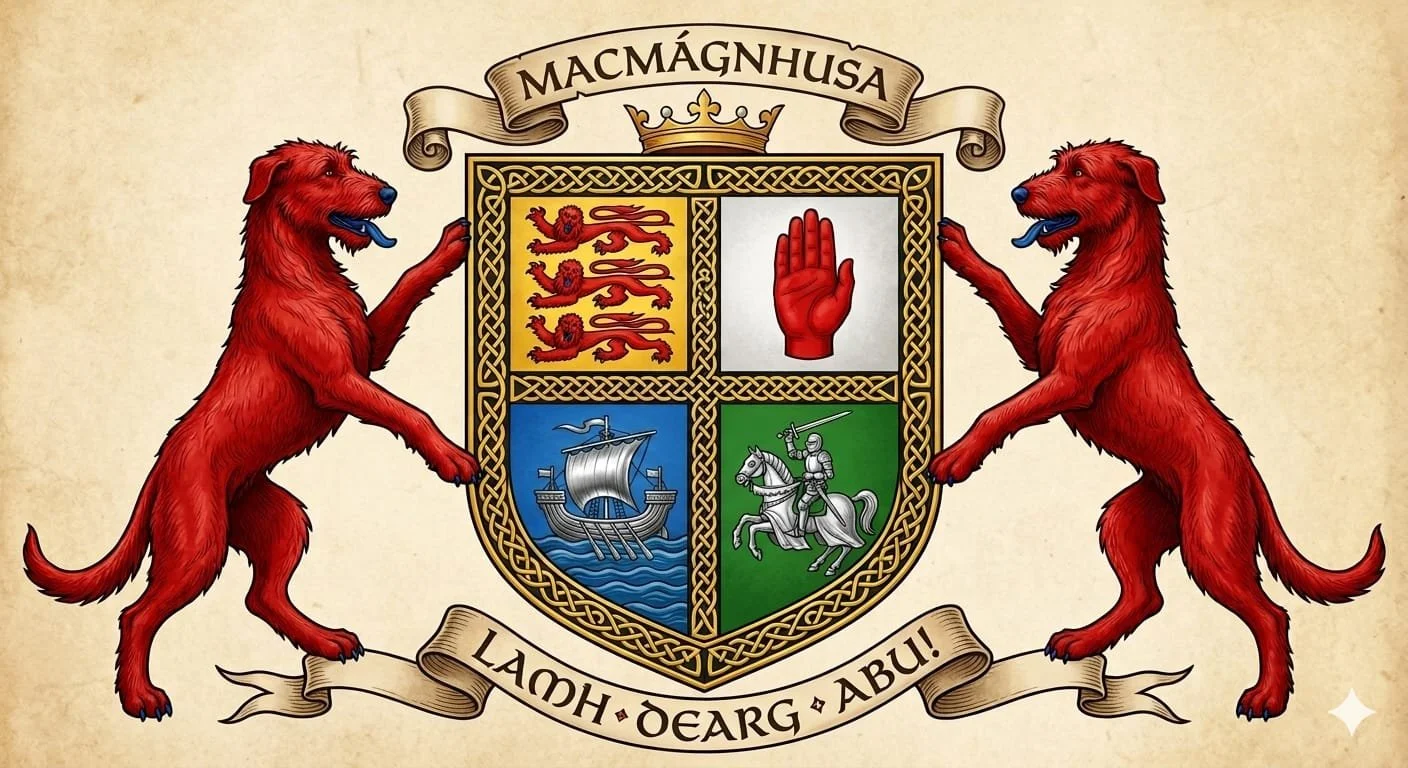
The Clan McManus\House of Magnhus CLG Coat of Arms captures the Clans lineage beautifully our two Irish Wolfhound supporters showing our Gealic Royale connection to the Maguires then our shield shows our ancestry with the Maguire represented in the bottom right and in the top right is our link to the De Burgh Earldom of Ulster but instead of Red Hand on Gold Field we have a Red Hand on a Silver Field, then in the top left is our Angevin connection with the colours reversed keeping with heraldic law and finally we have us the McManus Clan represented in bottom left with our Irish Galley showing our navel prowess.
After membership registration you will have access to the Clan WhatsApp group where all members will be informed about upcoming events and gatherings.
To live as a McManus is to carry a legacy of strength that is measured not by what we take, but by what we give. Our philosophy is a circle of protection—extending from the land beneath our feet to the neighbours by our side.
The McManus Clan Creed.
I. Charity: The Heart of the Clan
We believe that true prosperity is only realized when it is shared. To a McManus, charity is not an afterthought; it is a duty. We reach out to those in need not out of pity, but out of the understanding that we are all part of one story. When one of us rises, we reach back to pull another up.
II. Stewardship: Caring for the land and animals we share it with.
The land is our silent ancestor. We recognize that we do not own the environment; we borrow it and by caring for our natural world, we honour the roots that sustain us and ensure that the air, water, and soil remain vibrant for the generations of the Clan yet to be born.
III. Community: Taking Care of Our Own
A McManus never stands alone. We are the architects of a community built on radical kindness and unwavering support. We celebrate each other’s victories and shoulder each other’s burdens. Our bond is our greatest fortress.
IV. Vitality: Strength in Body and Spirit
We honour our lineage by keeping ourselves sharp, capable, and physically healthy. A strong body is the vessel for a strong mind and a resilient spirit. We stay fit so that we are always ready, ensuring we have the energy to serve our family and our mission.
V. Justice: Defending the innocent.
The McManus spirit is defined by courage. We stand as a shield for those who cannot defend themselves. We use our strength to confront injustice and our voices to speak for the silenced. To be McManus is to be a protector—the one who stands firm when others turn away.
"In our hands, there is help. In our hearts, there is heat." Lamh Dearg Abu! "Vital in Spirit, Vigilant in Mercy."
Historical Sources for content listed below.
Annals of Ulster (University College Cork CELT Project)
Annals of the Four Masters (Mícheál Ó Cléirigh.)
Brian G. Scott, The Maguires of Fermanagh (Ulster Local History Society)
Patrick J. Duffy, Fermanagh: History and Society (Geography Publications, 2004)
John O’Donovan’s Notes on Fermanagh in Ordnance Survey Letters (1834–36)
Clare Downham, Viking Kings of Britain and Ireland: The Dynasty of Ívarr to AD 1014
Sean Duffy, The Concise History of Ireland, Medieval Ireland: An Encyclopedia
O’Clery Book of Genealogies
The book of Ballymote
The books of Knockninny
A Fermanagh Story" by Father Peadar Livingstone (1969)
Clan Maguire: History of Clann Mac Uidhir
Irish Families: Their Names, Arms and Origins" by Edward MacLysaght
The Maguires of Fermanagh" (Library Ireland/Duffy’s Hibernian Magazine
From Kings to Warlords" by Katherine Simms
Julius Caesar:De Bello Gallico (for the Menapii in Gaul).
T.F. O'Rahilly:Early Irish History and Mythology (for the connection between the Manapi and the Fir Manach).
Francis John Byrne:Irish Kings and High-Kings (for the history of Airgíalla and the Ulaid).
Ptolemy’s Geographia: (The primary 2nd-century record of the Manapi in Ireland).
A guide to early Irish law Book by Fergus Kelly.
You-Tube Channell’s that helped this website links below they are a great source of Gealic history and culture.
.1 http://www.youtube.com/@Clans_Dynasties
.2 http://www.youtube.com/@IrishMedievalHistory
.3 http://www.youtube.com/@forasfeasa
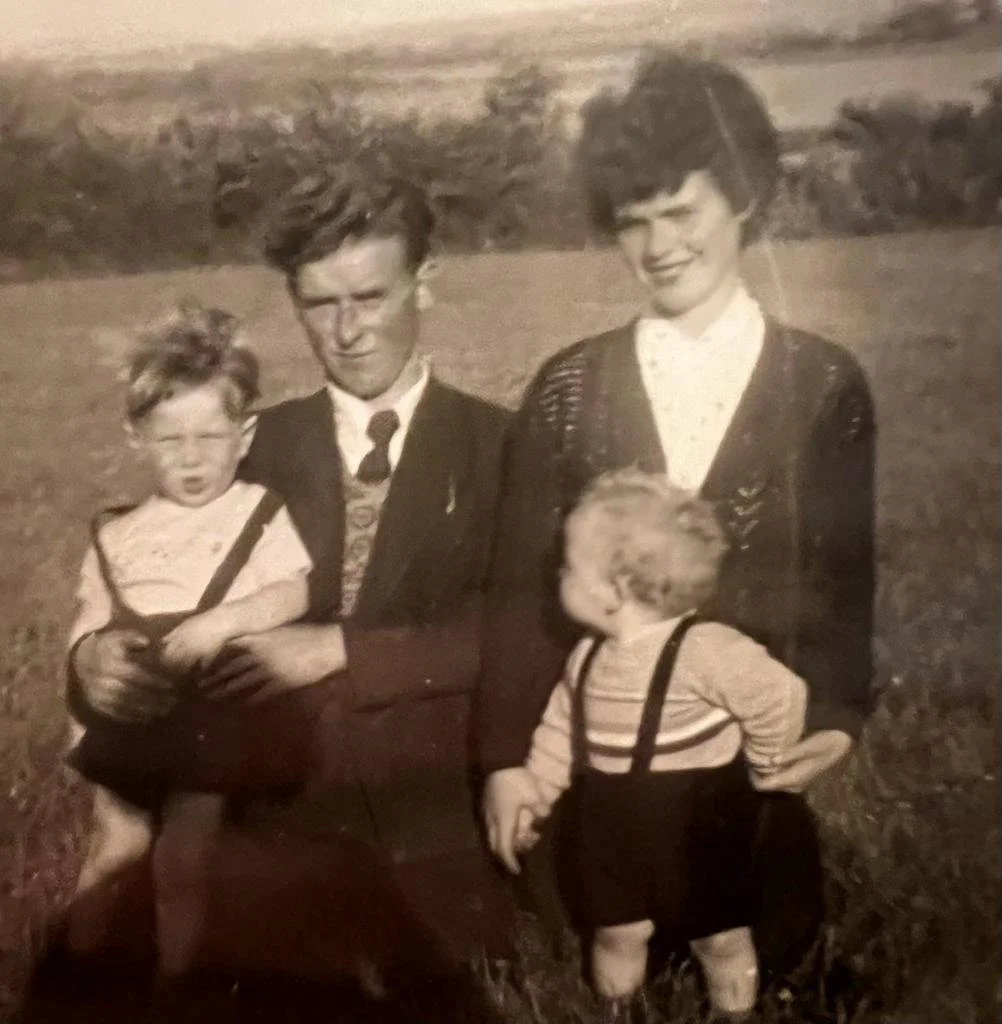
The photo is of Thomas Patrick McManus and his brother Martin McManus with their parent’s Thomas McManus 1918-1997 and Anne Martin 1934-1991 in the Clan Heartland of Fermanagh Knockninny early 1950s.
Anne Martin’s lineage can be traced backed to many royale and noble dynasties of Europe. With a proven documentation on Ancestry.com with files going back to Sir George Farewell 1579-1647 and Lady Mary Seymour 1580-1660. Margaret Farewell 1614-1670 was the daughter of Sir George and Mary, Margaret Farewell married John Relfe 1605-1654 James Relfe 1687-1724 was the great grandson of John Relfe 1605-1654 and James’s daughter Susanne Relfe 1717-1765 married Thomas Palmer 1714-1777. Anne Palmer 1773-Death unknown was the granddaughter of Thomas Palmer 1714-1777, and she married James McGovern 1773-1831. Mary Anne McGovern 1857-1921 was the granddaughter of James McGovern 1773-1831. Susane Blake birthyear unknown-1957 was the granddaughter of Mary Anne McGovern 1857-1921, Susane Blake married Patrick Martin 1896-1948, Patrick is Anne Martins father. Lady Mary Seymour 1580-1660 was the Great granddaughter of Edward Seymour Duke of Sommerset 1500-1552 from him we trace it back to Dame Margery Wentworth 1478-1550 and from her to Henry (Hot Spur) Percy 1364-1403 he famously died at the Battle of Shrewsbury. From Henry (Hot Spur) Percy 1364-1403 we trace it back to Edmund Mortimer 3rd Earl of March 1352-1382 and Philippa 5th Countess of Ulster 1355-1382, from her to Lionel of Antwerp 1338-1368 who was the second born son to Edward 3rd of England 1312-1377. Lionel of Antwerp’s Wife Elizibeth De Burgh 4th Countess of Ulster 1332-1363 was descended from the De Burgh Earls and Barons of Connacht and Ulster. Lionel of Antwerp 1338-1368 was also the great grandson of King Philip 4th of France 1268-1314. Elizibeth 4th Countess of Ulster 1332-1363 was the granddaughter of Elizibeth De Clare 1295-1360 who was herself the great granddaughter of Isobel Marshal 1200-1240, Isobel was the daughter of Sir William Marshal 1146-1219 he was a renowned knight of his time and he married Isobel De Clare 4th Countess of Pembroke 1172-1220 and daughter of Richard Strongbow De Clare 1130-1176 who was one of the first Cambro-Norman Lords to come in the Norman invasion of Ireland. Through King Philip 4th of France 1268-1314 we can traced our lineage back to Henry 1st of France 1008-1060 who married Anne of Kiev 1030-1075, Anne of Kiev was the daughter of Yaroslav the Wise 978-1054 he was Grand prince of Kiev. Anne of Kiev was also the daughter of Ingegerd Olafsdotter 1001-1050. Ingegerd Olafsdotter was the granddaughter of the famous last Pagan Viking King of Sweden Eric the Victorious 945-995. Through Edward 3rd of England 1312-1377 we can trace it back to Geofrey of Anjou 1113-1151 and Empress Matilda 1102-1167, Empress Matilda was the daughter of Henry 1st of England 1068-1135 and granddaughter of William the Conqueror 1028-1087. Empress Matilda was also the daughter of Matilda of Scotland 1080-1118. Matilda of Scotland was the daughter of Malcolm 3rd of Scotland 1031-1093 and Saint Margeret of Scotland 1045-1093. Saint Margeret of Scotland was the daughter of Edward the Exile 1016-1057; Edward the Exile was the son of Edmund Ironside King of Anglo-Saxon England 991-1016. Through the De Burgh family with their founder William De Burgh 1160-1206 married an O’Brien Princess linking them with the King’s of Thomond, Limerick, Munster and the O’Brien High King’s of Ireland and even Brian Buro himself. Geoffrey of Anjou 1113-1151 was the son of Falk 5th Count of Anjou 1089-1143; Falk was also King of Jerusalem from 1131 to 1143. Henry 1st of France 1008-1060 was the Great grandson of Hedwig 910-958; she was the daughter of Henry (The Fowler) King of East Frankia 876-936. Yaroslav the Wise 978-1054 was the great grandson of Saint Olga of Kiev 890-969. Hedwig 910-958 was the wife of Hugh Capet 898-956 who was the son of Beatrice Carolingian 880-931. From Beatrice Carolingian 880-931 we can trace it back to Emperor Charlamagne 748-814, Charlamagne was the grandson of Charles Martel 688-741. Charles Martel is famed for the battle of Tours where he defeated the Umayyad Caliphate. Charles Martel 699-741 was a direct male descendant of Saint Arnulf of Metz 582-647.
Anne Martin’s ancestry represents an extraordinary consolidation of Western history. Through documented preservation, her family tree serves as a living chronicle of Europe—uniting the Anglo-Saxon and Norman crowns of England, the High Kings of Ireland, the early Tsars of Russia, the Carolingian emperors, and the foundational monarchies of France and Scotland.
The study of genealogy reveals a profound truth about human interconnectedness: if one travels sufficiently far back in time, all individuals share a common ancestry. In the context of genealogical research, this reality is often unlocked by a "Gateway Ancestor"—an individual whose lineage is historically documented, thereby connecting modern descendants to ancient, noble, and royal houses. While every human being inherently possesses such foundational ancestors, the passage of time and the loss of historical records mean that only some families possess the verified documentation required to prove it. For the McManus family, this bridge to antiquity is fully illuminated.